
Hanover Park Directory Collections
No separately titled Hanover Park-only Polk run was verified. The strongest city directory shelf is regional. Schaumburg Township District Library identifies telephone, business, and criss-cross editions that overlap Hanover Park's growth, but each title must be checked for actual village coverage.
| Collection | Years | Where Held | Access |
|---|---|---|---|
| Chicago Suburban | 1958-1959 | Schaumburg Township District Library | Ask local-history staff |
| Roselle and Medinah | 1960-1970, selected editions | Schaumburg Township District Library | Physical holdings |
| Northwest Suburbs | 2000-2011 and 2016, selected editions | Schaumburg Township District Library | Verify edition coverage |
| SBC street-address series | 2004, 2005, 2007-2009 | Schaumburg Township District Library | Reverse address volumes |
| Haines Near North criss-cross | 2010-present | Schaumburg Township District Library | Verify current access |
Other runs include Roselle from 1928, Bartlett and Roselle from 1948-1949, and Chicago Northwest Suburbs on CD-ROM for 1982-1983. Record the publisher, title, year, page, and geographic heading for every find. A gap is not proof that a household moved.
Read a Hanover Park Directory Entry
A city directory entry is a dated lead, not a full household record. Telephone editions tend to begin with a surname. Reverse volumes begin with a street and number. Business editions use firm names or classified headings. The edition's own key controls every mark.
| Name | Surname, initials, and possible household notation |
|---|---|
| Work | Occupation, employer, or business when printed |
| Contact | Telephone and street address |
| Marks | Symbols defined by that publisher's key |
| Context | Residential, business, alphabetical, or reverse section |
- Criss-cross section
- A directory arranged by address or phone number.
- Householder index
- A list centered on a named household representative.
- Abbreviation key
- The publisher's legend for shortened words and symbols.
Trace Hanover Park Families by Year
Pair each Hanover Park city directory result with another dated source. The latest public federal census is 1950 under the 72-year release rule. Later work depends more on directory editions, deeds, newspapers, probate, cemetery records, and released oral histories.
- Start with a known name, address, and approximate year.
- Check the reverse volume, then the alphabetical name section.
- Repeat the search in the nearest earlier and later editions.
- Compare a public census year, keeping old township lines in view.
- Confirm the trail through deeds, newspapers, probate, or cemetery files.
Disappearance can mean a move, death, unlisted phone, title change, or missing edition. Search nearby place labels before drawing a conclusion. Hanover Park moved from shared 60103 postal treatment to 60133 in 2001, so Bartlett can remain a useful older catalog term.
Digital Hanover Park Memory
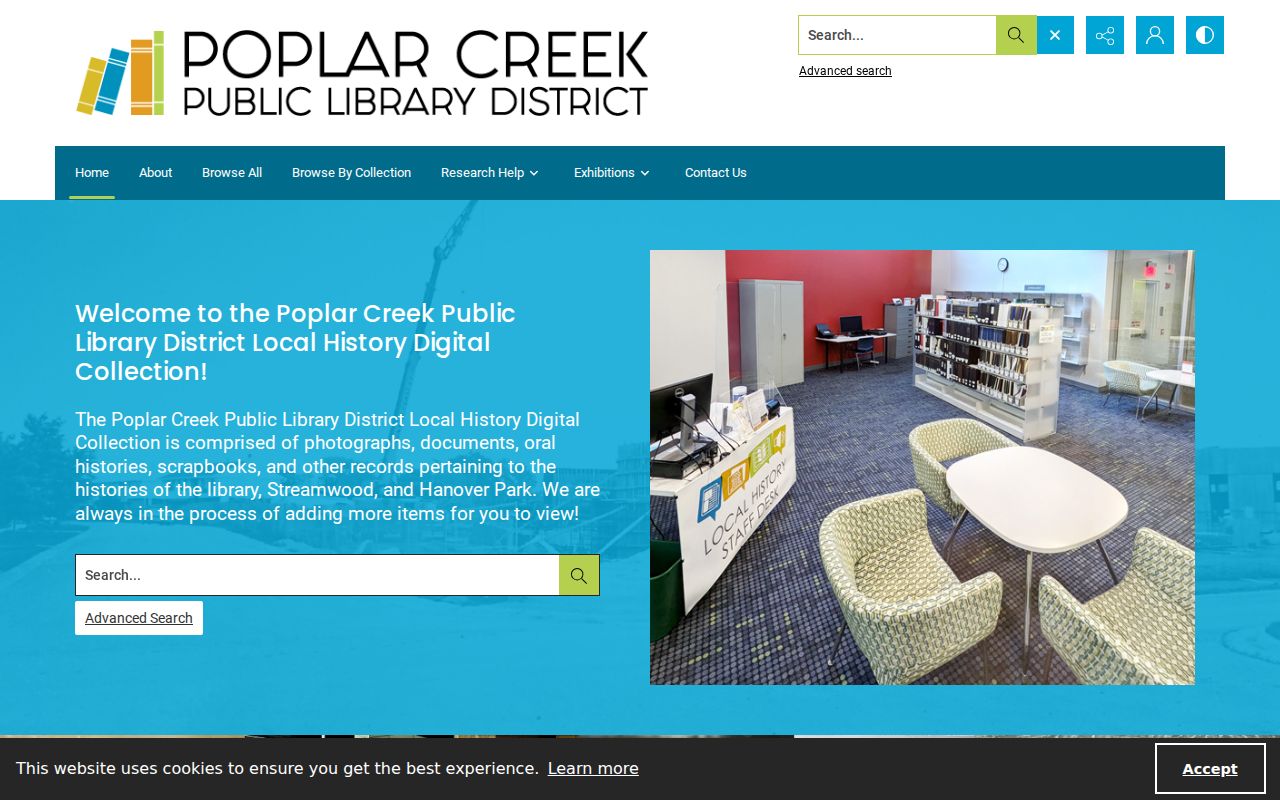
Poplar Creek Public Library's digital history collection contains Hanover Park photographs, documents, oral histories, scrapbooks, and library records. It supports search, advanced search, and collection browsing, and the library says material is still being added.
The captured collection shows the digital route into this growing archive.
Date each item before joining a name or address to a printed directory entry.
Hanover Park Newspaper Leads
The University of Illinois Newspaper Project lists Examiner of Hanover Park beginning in 1992 and the Hanover Park edition of Press for 1997-1998. This is a holdings locator, not a claim that all issues are open online. Schaumburg's local-history services also connect readers with Daily Herald, Tribune, obituary, genealogy, county-history, and atlas resources, some of which require a card or in-library visit.
Search a narrow window around the directory year. An obituary, announcement, or organization notice may distinguish two people with the same name.
Hanover Park Archive Fallbacks
The Schaumburg Township Historical Society preserves documents, photographs, ledgers, books, objects, and ephemera. No public name-indexed catalog was found. Hanover Park's Historic Committee also scans photos and artifacts and documents two historic cemeteries, but no public interment-name search was verified.
The archive capture shows the historical society's invitation to consult its holdings.
Ask staff about unscanned directories, cemetery books, church files, and IRAD county records when the shelf trail ends.
Check Hanover Park Directory Evidence
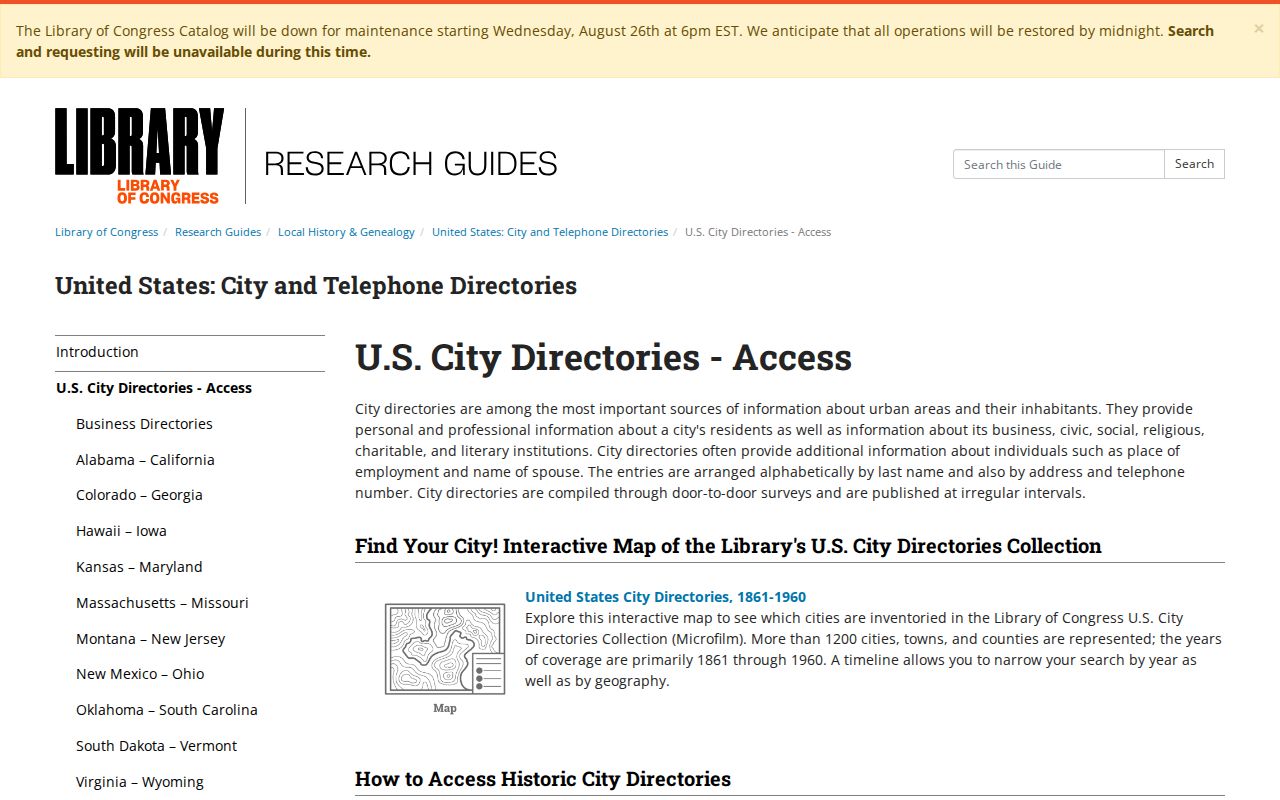
The Library of Congress city-directory guide explains why alphabetical and reverse arrangements work well for family and house history.
Cite the edition first, read its own key, and confirm identity with a deed, census, newspaper, probate file, or dated archive item.
Use Hanover Park's Regional Shelf
No verified Hanover Park-only Polk city directory run was found. The useful shelf is regional. Schaumburg Township District Library reports Chicago city directories for 1844, 1882, 1894, 1900, and 1917, plus Chicago Suburban telephone books for 1975 through 2004 with gaps. Its local holdings also include Roselle telephone books from 1946 through 2008 and Bartlett/Roselle books from 1957 through 2009, again with gaps. These year spans are holdings descriptions, not a promise that every volume contains every Hanover Park household.
A regional city directory should be searched under more than one locality. Try Hanover Park, Bartlett, Roselle, Streamwood, and Schaumburg, then check township and subdivision terms such as Ontarioville, Greenbrook, Woodlake Trails, Olde Salem, Longmeadow, and Turnberry. The community grew across municipal and postal lines, and a directory publisher could file the same street under a nearby exchange or postal label.
Call or ask the local-history desk before a trip. Staff can confirm whether a year is on the shelf, on microfilm, available through a database, or limited to in-library use. They may also point to an edition immediately before or after the target year. That adjacent volume often shows whether a household arrived, left, or merely changed how its name was printed.
Decode Hanover Park Directory Geography
A missing Hanover Park heading does not mean the household is absent from the shelf. The village developed inside a regional directory market, and the located volumes often use nearby towns or broad northwest-suburban labels. The Schaumburg Township District Library holdings include Roselle for 1928, Bartlett and Roselle for 1948 and 1949, and Bartlett, Roselle, and Bloomingdale editions from 1953 through 1959. Chicago Suburban North issues from the early and mid-1960s cover the same growth period from another regional angle.
Search an edition's geographic scope before rejecting it. A street now identified with Hanover Park may appear under Bartlett, Roselle, Bloomingdale, Schaumburg, a township, or a subdivision. The village chronology supplies useful search terms: Greenbrook developed in the 1960s, Woodlake Trails and Olde Salem followed in the early 1970s, and Ontarioville joined Hanover Park in 1982. A directory printed before one of those events may organize the same place under an older community name.
The postal shift adds another trap. A village notice says Hanover Park moved from shared 60103 treatment to its own 60133 ZIP on July 1, 2001. Older telephone books, newspapers, and personal papers may pair a recognizable address with Bartlett or 60103. Preserve that printed label in the citation. Modernizing it too soon can hide the clue needed to find the household in another source.
Compare Hanover Park Library Holdings
Hanover Park's library coverage overlaps municipal lines. Poplar Creek Public Library District serves roughly two-thirds of the village as well as parts of nearby communities. Schaumburg Township District Library brings a different regional footprint and the most specific located telephone-directory inventory. A failed catalog search at one library is not proof that no relevant volume survives. Check the other catalog, ask the local-history desk, and give the street, year, subdivision, and neighboring postal label.
The formats differ too. Some northwest-suburban issues are physical books, while the 1982 and 1983 Chicago Northwest Suburbs directories are listed on CD-ROM. Several databases linked from the genealogy and local-history pages require a library card or an in-library session. Ask whether staff can check an index, whether an appointment is useful, and whether copying rules apply. No usable sample page from a local volume was captured during research, so the abbreviation key in each actual edition remains the authority.
Poplar Creek's growing digital collection contributes photographs, oral histories, government papers, maps, organization records, and scrapbooks rather than a single printed directory run. Oral histories require release handling and may be redacted. Use those items to explain a directory entry, not to replace it. A dated photograph may confirm a business at an address, while an interview may clarify a subdivision nickname or family connection.
Place Hanover Park Entries in Time
Directory evidence becomes stronger when it fits the village's growth record. Hanover Park incorporated in 1958 with 305 residents. Official history then reports 451 residents in 1960, 1,845 in 1962, 3,713 in 1963, and 6,620 in 1965. Those figures explain why an early suburban edition may have sparse Hanover Park entries while a later northwest-suburban volume contains many more streets and firms.
The county line also changed the record trail. Hanover Park began on the Cook side, annexed roughly 750 acres of DuPage farmland in 1969, and later added other developed areas. Read a directory address against the annexation date, then confirm it with a plat, deed, census schedule, or newspaper. Do not assume that a modern village boundary controls a volume printed decades earlier. This check is especially useful when two editions place the same road under different town or township labels.
Corroborate Hanover Park Directory Names
A city directory entry is a dated clue, not a full household record. First copy the name, initials, spouse notation, occupation, telephone number, street address, and any owner or renter mark exactly as printed. Then read the abbreviation key for that edition. Publisher symbols changed, and an unexplained letter should never be expanded from memory.
Next, compare the entry with an independent source. The 72-year federal census release rule makes census schedules through 1940 available for historical work. A county deed can establish ownership, while probate, cemetery, church, obituary, or newspaper records may connect relatives and dates. The Illinois State Archives Regional Archives Depository search helps locate older Cook or DuPage county record groups when the needed book is not online.
- Record the directory title, publisher, year, page, and arrangement.
- Search the same name in the prior and next available editions.
- Check the address side of a reverse directory, if the volume has one.
- Compare a deed, census, obituary, or probate record from the same period.
- Keep conflicting spellings and labels in the research notes.
This method keeps a Hanover Park city directory useful without asking it to prove more than it contains. A missing entry may reflect a gap in the run, a move between publication dates, a different postal label, or an unlisted telephone, not the absence of the person from the community.
For a street-based entry, copy both the alphabetical listing and the reverse-address page. One may preserve a middle initial or spouse note that the other omits. When editions disagree, prefer the record closest in date to the event being researched and explain the conflict. Do not merge two households solely because a surname and street match.