
Hanover Park Address History Sources
A backward address search crosses several eras and two counties. The parcel card and deed index are strongest for ownership, while regional telephone and criss-cross volumes can identify an occupant who did not hold title. Federal census schedules add full household snapshots, but only released years are public. Village permit files, photographs, newspapers, cemetery records, and probate can fill narrow gaps. Before opening any index, use a Hanover Park address map to decide whether the parcel lies in Cook or DuPage County. A Hanover Park postal label alone does not settle jurisdiction.
| Source | Years It Covers | Where Held | What It Shows |
|---|---|---|---|
| DuPage deed index | Office: 1839 onward; online cutoffs vary | DuPage Recorder | Owners, parties, document dates, legal descriptions |
| Cook recorded documents | County land-record history; Clerk took over in 2020 | Cook County Clerk Recordings | Deeds, mortgages, liens, plats, and copies |
| Regional reverse directories | Located runs from 1928 through current Haines issues | Schaumburg Township District Library | Occupant or business listed by address |
| Federal census | Released schedules through 1950 | National Archives and library databases | Household members at one historical date |
| Village permit or code file | No complete public online run verified | Hanover Park request channel | Work, inspections, applicant, and public owner fields |
Start with the parcel card for a recent question, then move through deeds. For the mid- and late twentieth century, check a reverse directory between deed dates. For an address before incorporation or annexation, use township, subdivision, and neighboring postal names as well as Hanover Park. The census is the best household source for a released census year, while probate or an obituary may explain why title passed to heirs.
Start With Hanover Park's Parcel
The current parcel card gives the search a stable key. On the DuPage side, DuPage Property Lookup supports parcel, address, billing-name, and map searches. Its result can include the ten-digit PIN, situs address, billing name and address, tax year, assessments, exemptions, transfers, and districts. On the Cook side, use the Cook Assessor address search and the Cook Property Portal. Cook generally uses a fourteen-digit PIN.
Copy the PIN and legal description exactly. Also record the source date, situs address, and tax-mailing field, but keep those fields separate. A situs address locates the parcel. A tax address tells where the bill goes. Neither proves that the named owner lives there or identifies everyone in the household. This distinction prevents a property owner from being mislabeled as one of the previous residents.
Note: A company, tax agent, or out-of-town address on a parcel card is a billing clue, not proof of occupancy.
DuPage's Three Search Cutoffs
The DuPage Recorder document search has different online starting points for each key. Name indexing begins in 1961, PIN searching in 1985, and address searching in 1995. The Recorder's office research reaches back to 1839. That difference matters. A failed address query from 1980 does not mean the deed is missing. Search by the owner's name, use the PIN when its online period applies, or contact the Research desk for an older instrument.
The portal accepts last and first name, bank name, trust number, subdivision or business name, street fields, PIN, document number, document group and type, and a date range. Open the document number, review the details, and compare the legal description before treating a same-name result as part of the chain. For Cook properties, the old Recorder office is no longer a separate destination. The Cook County Clerk Recordings operation has handled that work since December 2020, with counter and copy routes available when the web gateway is not enough.
Trace Hanover Park Owners Backward
A chain of title is the sequence of recorded transfers for the same land. Work from the known present toward the unknown past. The legal description is vital because street labels and postal cities can change while the lot and subdivision remain the same. A deed names parties to a transfer, not every person who occupied the house. Treat ownership and residence as two separate tracks until a directory, census, or other source connects them.
- Pull the current PIN, owner or billing name, situs, and legal description from the proper county property system.
- Find that owner's purchase deed. Match the PIN, lot, block, subdivision, document date, and instrument type.
- Take the seller, who is the grantor on that deed, and search for the earlier deed where that party appeared as grantee.
- Repeat the handoff while logging document numbers and dates. Stop when the land description changes without an explained split or combination.
- At the online cutoff, call or visit the recording office with the last verified document, party names, PIN, and legal description.
- Grantor
- The party transferring an interest in the land.
- Grantee
- The party receiving the recorded interest.
- Chain of title
- The linked series of transfers for one parcel.
- Legal description
- The formal lot, block, subdivision, or boundary wording that identifies land more reliably than an old street address.
Previous Residents Before ZIP 60133
Older address searches need more than today's Hanover Park and 60133 label. A village notice records the move from shared 60103 postal treatment to 60133 on July 1, 2001. A directory, newspaper, letter, or older deed may therefore pair a familiar street with Bartlett or 60103. That mismatch can be useful evidence rather than an error.
Subdivision and settlement terms also change the search vocabulary. Try Ontarioville, Greenbrook, Woodlake Trails, Olde Salem, Longmeadow, and Turnberry where the time and place fit. Hanover Park incorporated in 1958, annexed DuPage farmland in 1969, and added Ontarioville in 1982. For land predating those events, county, township, subdivision, and plat terms may work better than the present village name. No official local street-renumbering project was found in the research, so verify any claimed number change against a plat, village engineering file, or postal record.
Hanover Park House History Shelves
No dedicated local house-history guide was located, but two regional library routes cover the gap. The Schaumburg Township District Library local-history desk has regional telephone and reverse-directory runs, newspaper databases, genealogy tools, and local collections. The Northwest Suburban Street Address Telephone Directory has located issues from 2004, 2005, and 2007 through 2009. Haines Chicago Near North Suburban criss-cross issues begin in 2010 in the located holdings. Earlier Bartlett, Roselle, Bloomingdale, and northwest-suburban editions reach into the period before Hanover Park had its current postal identity.
Ask staff about an exact street, year, edition, and publisher. The Poplar Creek digital collection adds Hanover Park photographs, papers, scrapbooks, and oral histories, and it is still growing. Search a subdivision or organization name along with the street. A photograph or clipping can date a structure or event even when it does not name each occupant. The broader method is explained on the Hanover Park city directory collections page, while the backward address chain remains the task here.
Growth Dates for Previous Residents
The village's rapid growth is a practical check on old claims. Hanover Park had 305 residents at incorporation, then 451 in 1960, 1,845 in 1962, 3,713 in 1963, and 6,620 in 1965. Those figures do not name past residents, but they help test whether a claimed street, subdivision, or directory label fits the year.
The Hanover Park timeline places Greenbrook in the 1960s, Woodlake Trails and Olde Salem in the early 1970s, and Ontarioville's annexation in 1982. Pair that chronology with a subdivision plat and deed date. A modern street in a later development should not be forced into a much earlier directory. The sequence also tells a librarian which neighboring town or township term may have held the address before annexation.
The village history page gives another view of these milestones and the community's development.
View the official Hanover Park history source used for these address-era checks.
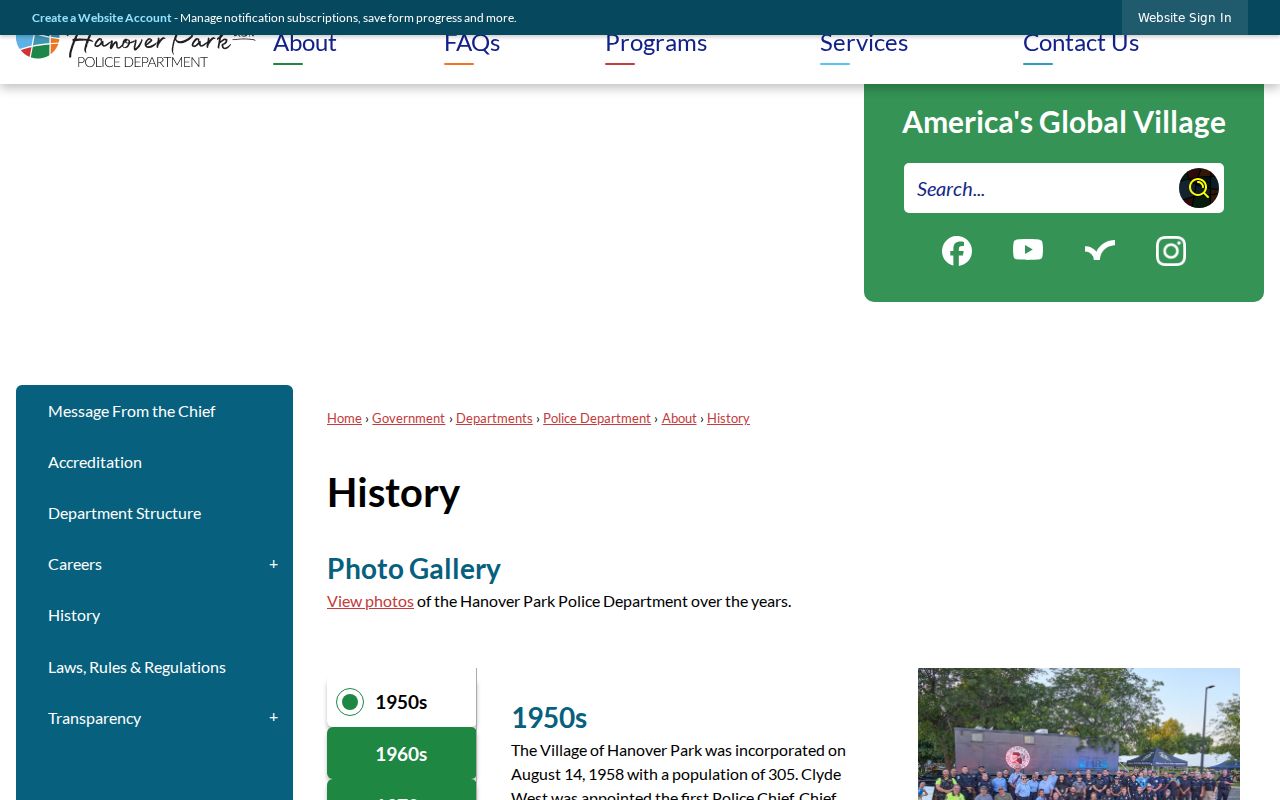
The image helps place an address search in the right growth period before names are compared across records.
The official village timeline gives the dates in a compact sequence. Open the Hanover Park timeline source for its annexation and development milestones.
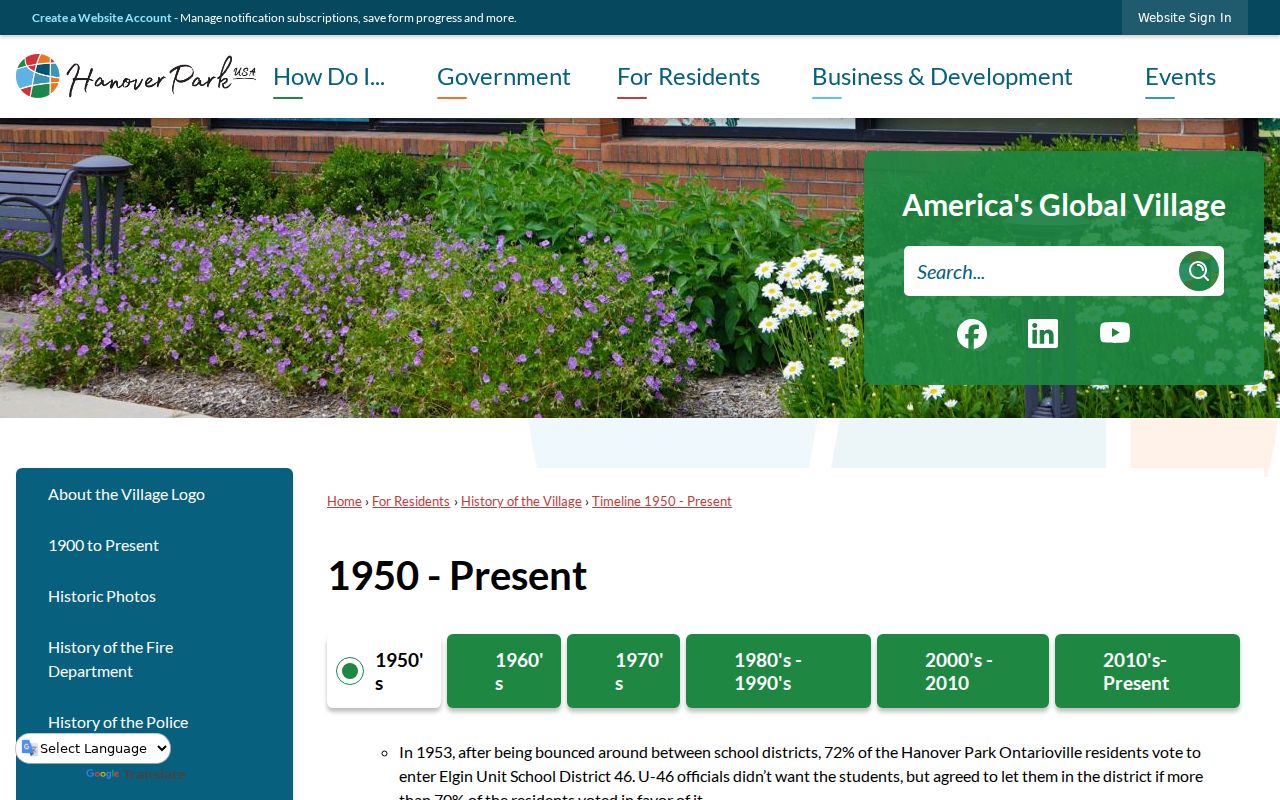
This dated source helps distinguish a true address gap from a parcel that had not yet joined the village or received its later subdivision name.
Offline Hanover Park Record Fallbacks
Web coverage ends before the record trail does. DuPage Recorder office research reaches 1839. Call the Research desk at 630-407-5401 with a document number, PIN, legal description, or grantor and grantee pair. Cook has public recording and copy channels through the County Clerk. The Illinois State Archives regional system also lists historic county groups, including DuPage marriage, naturalization, vital, and county-board series held through the Northern Illinois University depository.
For a village permit, inspection, code, or local administrative file, use the Hanover Park records route rather than a county land office. Make the request narrow: one property, a useful date range, and a record type. Illinois FOIA generally calls for a response within five business days, though exemptions and extensions can apply. Court probate files come from the relevant Circuit Clerk, not FOIA. This fallback chain preserves a clear handoff: online index, office research or request, archive or library, then newspaper and estate context.
Hanover Park Past Household Evidence
Owners are only one part of the answer. Reverse directories can name an occupant by street number, including someone who did not own the parcel. A federal census can show a whole household, relationships, ages, birthplaces, and other fields for its census date. The latest public decennial schedule is 1950 because federal census releases follow a 72-year rule. Obituaries, cemetery files, newspapers, and probate may then explain a death, move, inheritance, or family link.
Use a simple pairing flow: address and target year, then the nearest reverse-directory edition, then the nearest released census, followed by a name check in newspapers and probate. Record the title and year of each directory because coverage varies. A missing line in one annual volume is not proof that the household moved. Check adjacent years, alternate postal labels, spelling variants, spouse names, and the same legal parcel before deciding the chain broke.
The Hanover Park Historic Committee scans historic material and maintains documentation for two cemeteries, though no public name-indexed plot search was found. Poplar Creek oral histories can add memories where a release permits access. Such sources support past-resident research, but they should be labeled as recollection or curated history rather than treated as a current resident roll.
Lawful use. Research previous residents for house history, genealogy, estate work, or personal curiosity. Never use an address trail to stalk, harass, or harm a living person.